
Reconstructing Equity Splits from Historical Financial Contributions
Reconstructing equity splits from historical financial contributions converts documented cash, unpaid wages, and equipment into shares using risk-weighted multipliers.

Seat
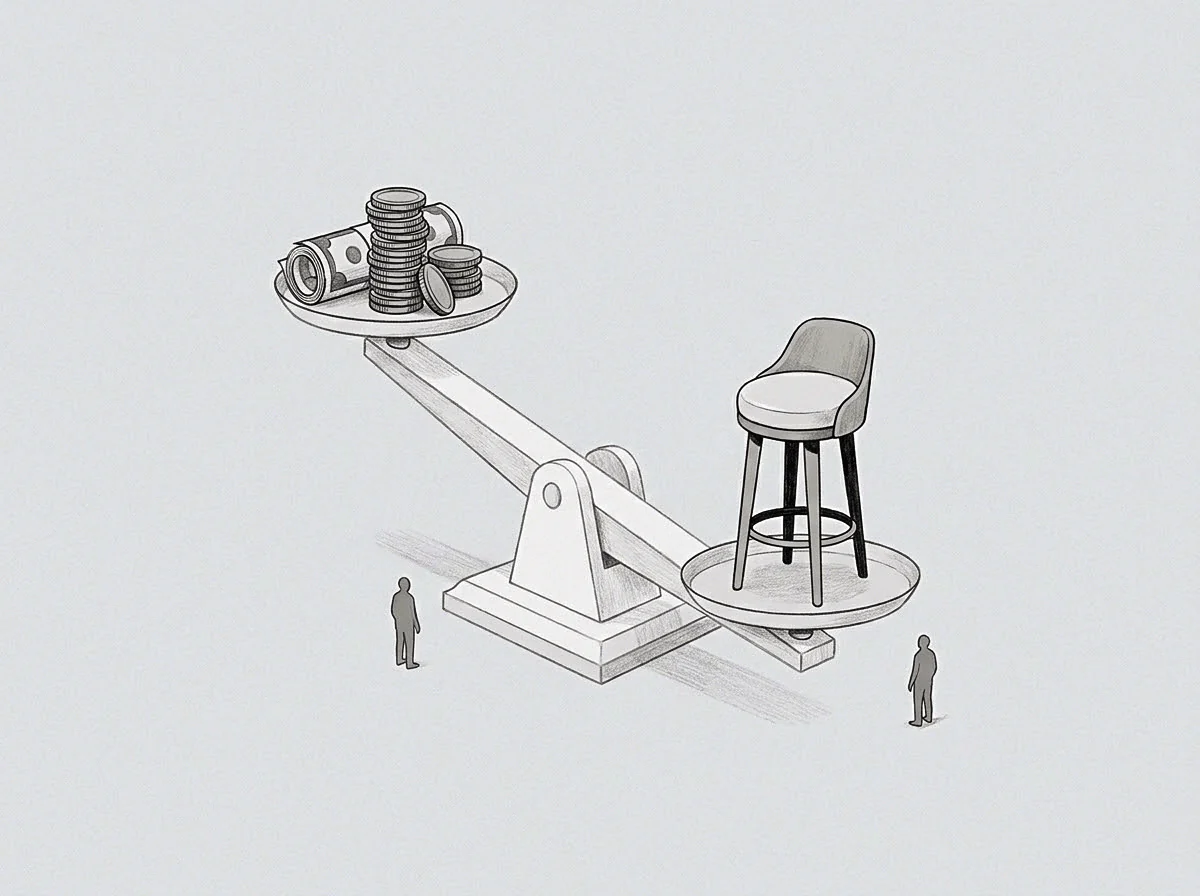
Early Capital Placed Against Unpaid Labor
Two people begin working together from separate desks with no written equity agreement. One puts fifteen thousand dollars into an account to pay incorporation fees, cloud hosting, and early suppliers. The second draws no salary for fourteen months while writing software or securing commercial trials.
Each acts under an internal tally that feels obvious from their own vantage point.
The contributor of funds tallies the card payments, wire slips, and personal guarantees against credit lines. The operator tallies fifteen hundred uncompensated hours, deferred market wages, and vanished savings. Neither account encounters the other until external capital arrives or one contributor leaves.
A financial input creates exposure immediately while uncompensated labor creates exposure over duration.
When external investors demand a clean capitalization table, the two recollections meet directly. The cash contributor remembers providing the vital life support without which nothing existed. The technical contributor remembers providing the actual asset while the money contributor acted as an informal lender.
The difference between these two reconstructions is where tension settles.
The investor does not arbitrate informal understandings. The funding round stalls until both parties accept a single capitalization table. The other party recalls paying every utility bill so the project could breathe.

Weight

Valuation Baselines for Direct Cash
Direct cash injected into an unpriced entity carries distinct risk characteristics depending on calendar timing. Ten thousand dollars wired when the company is an untested slide deck purchases different structural risk than ten thousand dollars wired after initial enterprise revenue. Converting that cash into ordinary equity years later demands establishing a baseline value for those early moments.
Parties frequently dispute whether cash supplied before corporate formation constitutes equity, debt, or a gift between collaborators. Where promissory notes were omitted, historical financial inputs get conflated with ordinary company loans. Imputed interest rates offer one baseline for restitution, whereas early-stage valuation proxies yield substantially higher ownership percentages.
Unpriced capital contributions compound in value when risk exposure stays unhedged across early months.

Quantifying Foregone Market Salaries
Uncompensated executive labor constitutes sweat equity, which represents foregone cash earnings converted into firm ownership. The standard quantification method sets the market replacement wage against actual compensation drawn, treating the unpaid variance as a periodic financial contribution. An engineer earning zero against a market rate of one hundred twenty thousand dollars contributes ten thousand dollars of monthly enterprise value.
This conversion encounters severe distortion when founders evaluate their historical market worth in hindsight. Disagreements arise over whether to discount the rate to reflect early startup distress or to apply an equity conversion premium to reward extreme risk assumption. The wage rate selected determines whether the technical contributor commands forty percent or seventy percent of the adjusted split.
Cash outlays outrank unperformed promises in every retrofitted settlement.

Model

Dynamic Contribution Slicing Systems
Dynamic contribution models treat pre-revenue equity allocations as an open tally rather than a fixed initial wager. Every contribution of cash, equipment, intellectual property, or sweat receives a calculated theoretical value. A risk multiplier applies to early inputs to acknowledge that early dollars and hours face complete loss compared to late additions.
Under these structures, cash typically earns a multiplier between two and four, while unpaid time earns a multiplier of one to two. The pool adjusts continuously until the firm reaches breakeven cash flow or closes an institutional financing round. At that precise transition, the accrued points freeze and determine the final proportional ownership split.
A contribution multiplier fixes the relative premium between liquid capital and sweat equity before ownership freezes.
How Historical Contributions Convert Across Divergent Valuations?
Resolving competing contributions involves comparing each input against its historical replacement cost and risk profile. The table below outlines how four primary contribution types are evaluated when retroactively assembling an ownership distribution.
| Contribution Category | Measurement Metric | Standard Risk Multiplier | Verification Source |
|---|---|---|---|
| Direct Liquid Cash | Actual out-of-pocket dollars deposited | Four times face value | Bank settlement records |
| Foregone Market Wage | Verified replacement salary minus drawn pay | Two times market rate | Historical payroll benchmarks |
| Tangible Equipment | Depreciated fair market value at transfer | One times asset value | Receipts and physical inventory |
| Intellectual Property | Third-party development replacement expense | One to two times direct cost | Code repositories and assignment agreements |
| Multipliers reflect standard dynamic slicing conventions applied prior to priced external investment rounds. | |||
Applying the table requires mutual agreement on market salary baselines. If one person claims an inflated executive rate of three hundred thousand dollars for operational support, the entire conversion balance tilts artificially. Agreement on baseline figures must precede the calculation of ownership percentages.
The retroactive conversion agreement converts documented early loans into restricted stock units vesting immediately upon execution.

Gap

Divergent Records and Reconciliation
Memory reconstructs past arrangements through present self-interest. Empirical findings on shared event recollection demonstrate that collaborating partners recall their individual contributions as twenty to forty percent higher than counterparties record. When collaborators reconstruct three years of informal expenditures, the sum of claimed percentage contributions routinely exceeds one hundred and thirty percent.
Reconciling this divergence requires hard documentation standards that supersede personal recollections. Acceptable records follow specific evidential hierarchies:
- Bank account debits establish unarguable dates and monetary amounts for third-party obligations.
- Dated communications verify mutual contemporaneous consent regarding capital injections and expectations.
- Time-tracking archives corroborate persistent operational output rather than intermittent availability.
- Formal IP assignments prove the actual corporate transfer of software code, trademarks, or trade secrets.
Without written terms from the beginning, retrospective reconciliation becomes a zero-sum renegotiation. One party views concessions as an unearned gift while the other views them as rightful compensation for unpaid toil. Stalled negotiations cause venture deals to collapse, leaving both parties holding complete equity in a defunct entity.

Term

Formalizing the Retroactive Equity Settlement
Once the mathematical conversion produces agreed ownership percentages, the founders execute formal instruments to replace past informal understandings. A comprehensive settlement agreement includes full mutual releases, confirming that neither party holds outstanding debt claims or deferred compensation entitlements against the enterprise. Unrecorded cash inputs are formally categorized as either capital contributions purchasing shares or extinguished shareholder loans.
The restructured equity must enter a vesting arrangement, even for work performed years prior. Investors will not fund a venture where founders own substantial equity outright without future performance obligations. The historical reconstruction earns founders credit toward vesting cliffs, granting immediate vesting for elapsed time while subjecting remaining shares to ongoing milestones.
A retrofitted cap table dissolves future debt claims through executed stock purchase agreements.
The settlement document seals the historical ledger permanently. Tax implications regarding phantom income or cheap stock issuance demand direct attention from corporate counsel. The company proceeds on clean footing, free of lingering verbal arrangements.
Whether future founders will document expenditures immediately or repeat the postponement remains undecided until the next cycle begins.