
Establishing Cryptographic Baseline Logs For Early Team Agreements
Cryptographic baseline logs freeze early team agreements into immutable timestamped digests, preventing memory drift and establishing unalterable sequence proof.

Erosion
Two founders agree on an equity split over coffee during the second week of build. One records fifty percent in a personal notebook while the other notes sixty percent in a private spreadsheet. Neither references the conversation for nine months while product assembly demands eighty hours each week.
When institutional investors ask for a definitive cap table before issuing a term sheet, both founders recall the coffee meeting with complete, contradictory conviction.

Reconstructive Memory in Early Venture Formation
Memory shifts past arrangements to match present valuations. Rather than retrieving fixed events from storage, recollection actively reconstructs them around current identity, emotional investment, and financial exposure. As early risk turns into measurable enterprise value, retrospective recall inflates a founder’s own perceived contribution while discounting the work done by others.
Unwritten promises develop an implicit gap between the original verbal agreement and later recollections, whereas written records establish a stable baseline.
Two partners remembering an unwritten equity split six months later construct conflicting records with identical personal confidence.
This drift speeds up when operational roles shift faster than cap table documentation. A partner who takes on unexpected software architecture work gradually begins to treat past equity conversations as having included performance adjustments, even if the exchange contained no such term. Without a fixed reference point set at the time of agreement, both founders fall back on internal recollections that diverge over time.

The Divergence Spectrum of Informal Agreements
Unwritten commitments decay under operational strain. Early team friction rarely starts with bad faith; it begins with the unmonitored drift of informal understandings across normal working cycles.
- Verbal Consensus initial conversations set provisional expectations regarding vesting schedules and equity distribution without generating verifiable artifacts.
- Selective Recall memory constructs divergent versions of the original terms as individual contributions accumulate over subsequent months.
- Asymmetric Expectation undocumented splits create unstated assumptions about future resource allocation, role titles, and intellectual property ownership.
- Structural Dispute funding events or departure notices force the reconciliations of incompatible memories, exposing unaddressed governance debt.
Standard text documents offer little protection against revisionism. Plain text files permit retroactive modification, timestamp adjustments, and deletion without leaving technical evidence of tampering. In a dispute, an unauthenticated digital file serves only as an assertion rather than an evidentiary record.
The agreed share stood at forty percent because the early technical contribution carried full risk before funding arrived.

Lock
Protecting an early agreement against drift requires converting plain prose into a fixed cryptographic output, turning subjective commitments into deterministic, unalterable digital digests.

Payload Serialization and Hash Function Selection
Structured text must convert into a standardized byte sequence before digest calculation. Because minor variations in whitespace, key order, character encoding, or line endings alter the resulting hash entirely, canonical serialization is an essential preliminary step. Founders serialize agreement text into canonical JSON, ordering keys alphabetically and encoding strings in UTF-8 before applying the hash function.
Running the canonical text through Secure Hash Algorithm 256-bit produces a 64-character hexadecimal digest. SHA-256 is mathematically irreversible and collision-resistant; modifying a single character across a hundred-page founder agreement produces a completely uncorrelated hash output.
A SHA-256 digest binds a canonical text payload to its precise cryptographic state only when the underlying JSON attributes follow strict key sorting.
Generating hashes across sequential agreements establishes an audit trail. Each log entry embeds the cryptographic digest of the prior agreement, forming an append-only sequence where any break points directly to modification or missing text.

Timestamping Mechanisms and Immutable Ledger Anchors
Tying a digest to a specific point in time requires external proof. Operating system timestamps provide minimal evidentiary value because local clocks can be altered. Reliable baseline logging relies on public distributed ledgers or cryptographic timestamp authorities to verify that a hash existed at a given moment.
Anchoring embeds payload digests directly into immutable transaction metadata. Once confirmed in a transaction block, the digest carries a permanent temporal record that cannot be modified by any single participant.
| Mechanism Type | Proof Depth | Setup Friction | Verification Dependency | Key Exposure Risk |
|---|---|---|---|---|
| Local SHA-256 Hash | Low | Minimal | High | None |
| Signed Git Commit | Medium | Low | Medium | Low |
| RFC 3161 TSA Stamp | High | Medium | External Authority | Low |
| Public Ledger Anchor | Absolute | High | Decentralized Ledger | Minimal |
Pairing local canonical serialization with public timestamping creates a lasting record. The team keeps the underlying prose private while publishing only the mathematical digest to public infrastructure.
Failure to lock agreement payloads at creation leaves early equity splits vulnerable to complete reconstruction during institutional due diligence.

Scope
A cryptographic digest proves textual immutability without guaranteeing shared understanding. Recognizing what baseline logs actually verify prevents over-reliance on technical tools during commercial disagreements.

Probative Weight in Legal and Arbitral Proceedings
Evidentiary standards treat timestamped hashes as technical corroboration. An authenticated cryptographic baseline log meets the criteria for establishing document integrity under standard rules of evidence.
Fact-finders rely on baseline logs to clarify specific questions of timing and document state, since the digest confirms that a particular set of words existed in a specific configuration on a given date.

How Does Cryptographic Proof Stand Up in Legal Arbitration?
Dispute resolution panels examine whether digital entries satisfy statutory business record exceptions. Arbitrators distinguish between payload immutability and contract enforceability. A cryptographically anchored document proves text creation date, yet it does not automatically invalidate claims of duress, unconscionability, or lack of legal capacity.
An unadjusted payload hash verifies that the text remains unaltered, yet leaves the underlying consensus open to challenge if mutual asset assignment was unstated.
When participants present contradictory accounts of early equity grants, an anchored hash shifts the burden of proof to the party claiming alterations were made, since matching a SHA-256 digest to an anchored ledger entry disproves post-hoc fabrication.

The Boundary Between State Intent and Text Integrity
Verification confirms which words existed on a specific date, but leaves the underlying commercial intent open to interpretation. Mathematical logs secure static phrasing rather than intent, meaning ambiguous language inside a locked payload remains ambiguous when read later.
Textual immutability is distinct from broad legal enforceability. A baseline log containing incomplete vesting schedules or omitted intellectual property transfers preserves those gaps just as permanently as the terms written down.
A signed cryptographic commitment clause converts a disputed verbal promise into a verifiable timestamped payload.

Workflow
Setting up a baseline logging routine requires operational discipline among partners. Applying cryptographic logs with minimal administrative friction protects execution pace while preserving accurate records.

Multi-Signature Key Ceremonies for Early Teams
Asymmetric public key cryptography enables participants to sign agreement digests independently. Every team member generates an elliptic curve key pair, storing private keys in secure physical keychains or hardware modules while exchanging public keys during initial setup.
Signing serialized agreement payloads requires all founding participants to apply their private keys to the generated SHA-256 digest. This multi-signature process ties identity to content, generating a combined signature block that confirms both text integrity and shared assent.
Commit the baseline hash whenever an unwritten expectation changes a team member’s weekly allocation.
Key management protocols need clear recovery procedures, including splitting key fragments across offline locations to prevent total loss of access if a hardware key is lost or a keyholder leaves.

Cadence and Amendment Protocols for Immutable Logs
Modifications to initial terms require generating an entirely fresh cryptographic record. An immutable baseline log cannot undergo direct editing. Amendments exist as new canonical payloads referencing the SHA-256 digest of the previous agreement block.
- Payload Serialization JSON formatting converts renegotiated terms into a canonical byte sequence sorted alphabetically.
- Digest Generation cryptographic algorithms calculate the SHA-256 digest of the new payload combined with the prior log hash.
- Public Timestamping ledger transactions anchor the new digest to an immutable public block.
- Key Custody signature protocols verify identity by requiring all active co-founders to sign the updated block.
A steady logging rhythm prevents governance divergence. Teams commit new cryptographic logs at distinct inflection points: changes in equity allocation, intellectual property assignments, contractor transitions, and major operational pivots.
Log every equity modification immediately after verbal consensus, before work under the new arrangement starts.

Limit
Cryptographic logging systems operate solely on digital inputs. Algorithms provide mathematical integrity for stored data, but they do not account for shifts in human relationships.
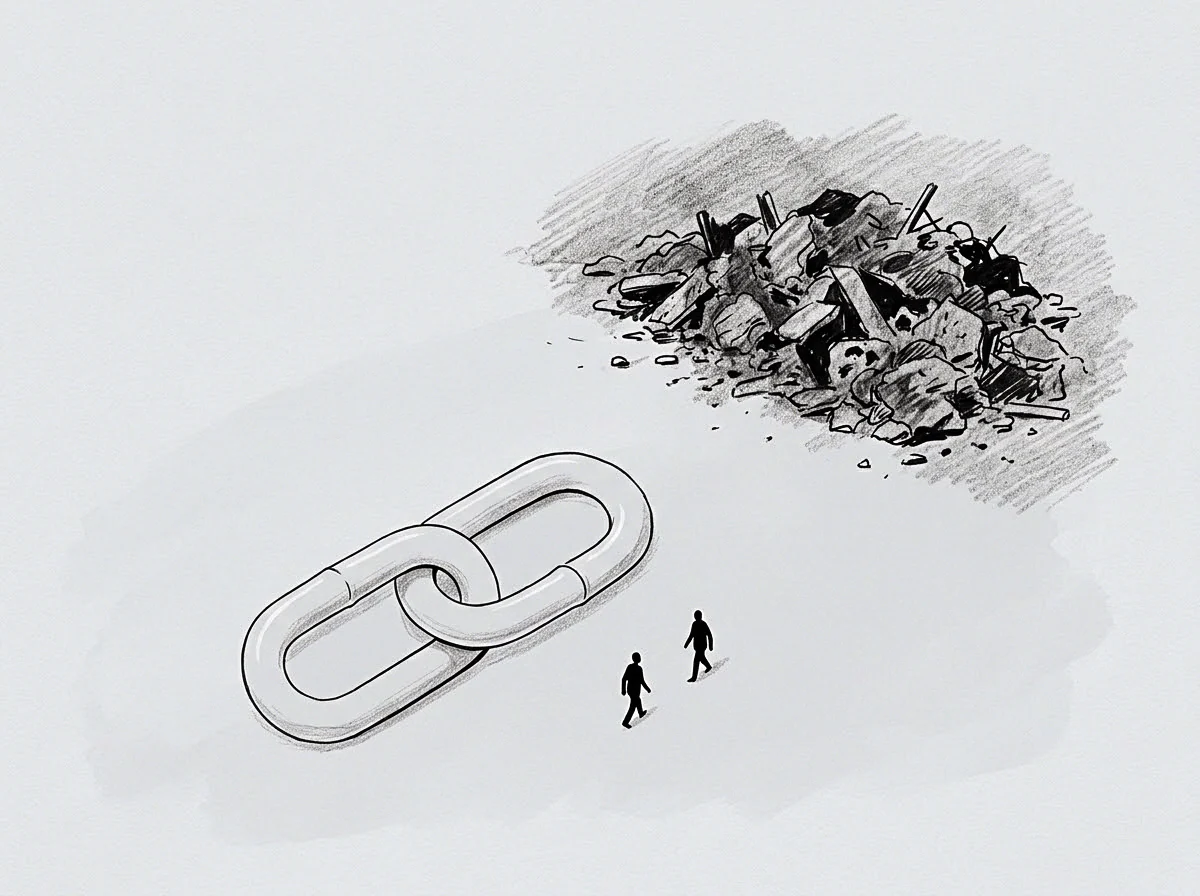
Governance Debt and Key Management Vulnerabilities
Misplaced cryptographic keys create total operational loss of verification capacity. If founders lose access to private signing keys, validating historical log authenticity becomes technically impossible without reliance on external trusted third parties.
Over-engineering baseline routines risks organizational slowdown. Complex ceremonies and constant manual payload hashing often prompt founders to drop logging entirely, returning to undocumented verbal exchanges that leave the venture exposed to reconstructive memory.

The Human Frontier of Mathematical Proof
Algorithmic certainty cannot resolve core interpersonal conflicts. A timestamped payload hash cannot compel an estranged partner to continue working on an struggling venture.
The primary cost of baseline logging is the attention needed to maintain canonical records during periods of rapid development. Committing to that process early avoids expensive evidentiary disputes during liquidity events.
Whether mathematical certainty in documentation can withstand radical shifts in interpersonal trust remains an open operational question.