
Documenting Unwritten Partnership Promises Before Disagreements Expand Later
Contemporaneous written agreements extinguish divergent memories of oral promises by establishing single, binding legal records before commercial friction expands.

Table
Two colleagues sit across from each other in a diner booth, sketching out commercial responsibilities on a paper napkin. The conversation moves rapidly across software architecture, sales commissions, initial equity splits, and operational authority. Both leave with complete confidence in their mutual understanding, as spoken commitments feel permanent while enthusiasm remains high.
Months pass before the consequences of unwritten commitments emerge. One operator writes source code for seventy hours each week under the assumption that labor earns half the equity. The other participant secures three introductory client calls under the belief that personal industry reputation justifies sixty percent of the venture.
Neither person inspects the underlying assumptions of the other. The work advances on parallel tracks, held together solely by spoken phrases that each side interpreted differently on the afternoon of the initial discussion.
Informal equity conversations feel binding while enthusiasm remains high.

The Informality of Initial Commitments
Entrepreneurs avoid formal contracts during early formation to preserve speed and avoid interpersonal friction. Drafting legal instruments introduces difficult questions regarding failure modes, vesting schedules, and intellectual property ownership, and many operators treat written contracts as an implied accusation of bad faith. Oral agreements allow collaborators to maintain an illusion of total alignment while avoiding uncomfortable negotiations over dilution, IP assignment, and operational shortfalls, purchasing short-term emotional comfort at the cost of substantial latent administrative liability.
Informal arrangements operate on social trust until capital, revenue, or external investors enter the environment. The arrival of liquidity alters the perceived stakes of the venture. When real balance sheets replace hypothetical milestones, informal commitments undergo severe stress.
The person who contributed five thousand dollars of initial capital recalls a loan with equity conversion rights. The person who received the cash recalls an unconditioned seed gift between friends. Without a dated physical record, each individual reconstructs the financial transaction to match their present sense of fairness.

Silent Divergence in Parallel Work
Operational reality constantly diverges from early informal blueprints as market conditions force adjustments in product strategy, pricing, and workload distribution. In an informal partnership, these operational adjustments occur without corresponding amendments to the underlying ownership structure. One partner takes on executive management, customer support, and financial administration due to operational necessity.
The second partner continues performing only specialized advisory work as originally envisioned.
As the gap expands, the executive partner begins resenting the inactive collaborator, assuming equity automatically shifts toward active labor, while the advisory collaborator assumes original equity allocations remain immutable regardless of operational variance. Both views are internally consistent and rest on coherent rationales, yet neither party articulates their stance because daily operational fires consume available attention. The initial conversation had simply granted half the commercial rights once the prototype functioned.

Divergence
Human recollection reconstructs past events according to current incentives and emotional states, operating through active reconstruction rather than passive video playback. In shared collaborative efforts, individuals consistently over-index on their own contributions while underestimating the contributions of their peers. This cognitive bias generates genuine, deeply felt disagreements where neither participant acts dishonestly, and these divergent recollections harden over time.
Empirical studies on self-serving attribution in collaborative tasks evaluate cohorts of project managers dividing credit for joint outcomes. Participants routinely claim individual contributions that total between one hundred twenty and one hundred forty percent of the aggregate project output. When applied to partnership equity, this mathematical impossibility produces immediate relational conflict.
The coding partner recalls an explicit promise that equity would vest based on functional software deployment. The commercial partner remembers an unconditioned grant designed to attract early investment. Both positions rest on sincere autobiographical memory.
When operational duties expand beyond the original discussion, reconstructed memory attributes greater ownership to present labor.

Reconstruction of Oral Commitments
Memory decay accelerates when verbal commitments involve conditional or deferred milestones, particularly since conversations over phone calls or informal drinks leave no contemporaneous trace. As time elapses, each participant fills memory gaps using present priorities as an interpretive anchor, transforming exploratory scenarios into absolute promises.
Unwritten promises undergo continuous subtle revision as the business matures. The participant who sacrificed a corporate salary remembers every verbal reassurance as an enforceable guarantee of commercial primacy. The participant who provided corporate credit cards views those same statements as informal words of encouragement.
When these divergent narratives inevitably collide during an equity financing round or corporate dissolution, both individuals experience profound betrayal, stemming entirely from unrecorded ambiguity.

The Drift of Unstated Assumptions
Unspoken expectations accumulate across three distinct operational areas, compounding the distance between partners over time:
- Role expansion without compensation occurs when operational duties multiply while the agreed equity distribution remains static.
- Deferred equity vesting triggers leave ownership percentages vulnerable to conflicting recollections regarding product release targets.
- Capital contribution conversion terms create friction if cash injections transform into ownership shares rather than debt repayments.
When unstated assumptions remain unaddressed, operational efficiency degrades as partners spend cognitive capacity assessing peer commitment rather than executing business strategy. Communication patterns shift from transparent strategic debates to guarded procedural interactions. Unaddressed disparities in recollection compound until legal representation replaces operational collaboration, consuming capital reserves and terminating the venture.

Audit
Examining historical verbal commitments requires systematic cataloging of all unwritten understandings before formal documentation can occur. An audit extracts historical verbal exchanges from personal notes, old message logs, software commit histories, and bank records to establish the factual baseline of the venture. By assembling every contemporaneous record, the operators transform vague, disputed recollections into an objective record of contributions and discussions.
The process of auditing early promises often exposes immediate discrepancies between partner expectations. One partner may discover that their perceived fifty percent equity share is reflected in the corporate filing as twenty percent with thirty percent unallocated options. Another partner may realize that personal intellectual property created prior to incorporation was never legally transferred to the corporate entity.
Identifying these gaps early allows partners to resolve differences while capitalization values remain low and relational goodwill remains accessible.
| Venture Dimension | Spoken Understanding | Documentary Evidence | Operational Exposure |
|---|---|---|---|
| Equity Allocation | Equal split promised during informal diner conversation. | Initial corporate formation documents list a sole incorporator with one hundred percent of shares. | Minority collaborator lacks legal standing to claim stock without expensive judicial reformation. |
| Intellectual Property | Proprietary algorithms created prior to founding belong to the venture. | Software repositories registered under individual personal accounts with no signed assignment agreement. | The venture lacks verifiable title to primary commercial assets, blocking institutional investment. |
| Capital Contributions | Initial funds treated as flexible operational seed money. | Personal bank transfers to business account marked as direct loans without interest or maturity terms. | Contributing partner can demand immediate repayment, precipitating corporate insolvency during cash pinches. |
| Compensation Timing | Salaries deferred until the company achieves sustained cash flow. | No written deferred compensation agreements or board minutes approving future back-pay calculations. | Department of Labor wage claims arise if an active collaborator departs before profitability. |

Cataloging the Existing Oral Commitments
Partners perform an audit by assembling all historical digital artifacts into a unified timeline. Electronic mail threads, text messaging channels, task board assignments, and code repositories contain objective evidence of initial intentions. A message stating that a partner will receive twenty percent upon delivering a payment gateway provides concrete boundaries that narrow divergent memories and limit the scope of opportunistic revisionism.
Contemporaneous documentation carries substantial evidentiary weight in commercial contract disputes. Even informal digital communications demonstrate mutual assent to specific milestones. When partners review this documentary timeline together, emotional arguments yield to chronological facts, forcing both parties to confront the concrete reality of what was actually said versus what was subsequently imagined.

Comparative Examination of Conflicting Records
Discrepancies identified during an audit demand immediate structural remediation. When spoken intentions contradict written records, the parties must decide whether to amend the documentation or conform their business practices to existing legal structures, as delaying this reconciliation magnifies the eventual financial cost required to correct ownership tables.
A formal condition precedent requiring mutual written ratification of equity grants before product launch prevents historical conversations from asserting unvested control.

Instrument
Reducing unwritten partnership promises to written instruments converts volatile human recollection into enforceable structural terms. Drafting legal documentation provides an objective framework that survives operational changes and interpersonal conflict, with the comprehensive settlement and ratification agreement—often paired with an amended operating agreement—serving as the primary instrument for resolving unwritten commitments.
A properly structured ratification agreement acknowledges all past contributions, explicitly cancels any prior oral or written promises, and establishes the definitive current rights of each participant. Serving as a firewall between early informal arrangements and mature corporate structure, it eliminates lingering ambiguity regarding ownership, profit shares, and intellectual property titles.
An integration provision voids prior oral agreements and establishes the written document as the sole governing record.

Documentation Vehicles for Historical Promises
Different categories of unwritten commitments require specialized contractual instruments to ensure enforceability and tax compliance:
- Recital of historical contributions documents past milestones achieved by each participant to establish equitable context.
- Explicit equity vesting schedules establish four-year time horizons with one-year cliffs to align future incentives.
- Intellectual property assignment clauses convey all proprietary materials developed prior to legal incorporation into corporate ownership.
- Integration provisions supersede preceding oral discussions and extinguish unrecorded commitments.
The integration provision acts as the legal cornerstone of this documentation process. Known colloquially as the entire agreement clause, this sentence explicitly affirms that the written document contains the complete and exclusive agreement between the parties. Any oral promise made in a diner, over a phone call, or within a text message string ceases to possess legal vitality once the parties execute an integrated agreement.

Structural Mechanics of Written Ratification
Memorializing past promises involves complex tax considerations, particularly regarding equity grants. Issuing corporate shares in exchange for past services creates immediate taxable events for the receiving partner under federal tax codes. If equity is granted after the business has gained measurable valuation, the recipient incurs significant income tax liabilities without receiving cash liquidity.
Attorneys navigate this friction by structuring historical recognitions through profits interests in limited liability companies, restricted stock subject to timely tax elections, or structured promissory notes that convert upon qualified financing events. Choosing the appropriate legal mechanism requires balancing administrative simplicity against personal tax exposure, as whichever party writes down the shared recollection sets the baseline for any subsequent negotiations.

Transition
Introducing written documentation to an existing informal partnership requires deliberate framing, as founders frequently worry that presenting a formal contract signals distrust or anticipates litigation. Navigating this conversation means decoupling formal documentation from personal sentiment. Framing the process around institutional readiness works well: professional investors, bank lenders, and enterprise customers require clean corporate records, clear intellectual property assignments, and undisputed cap tables before transacting.
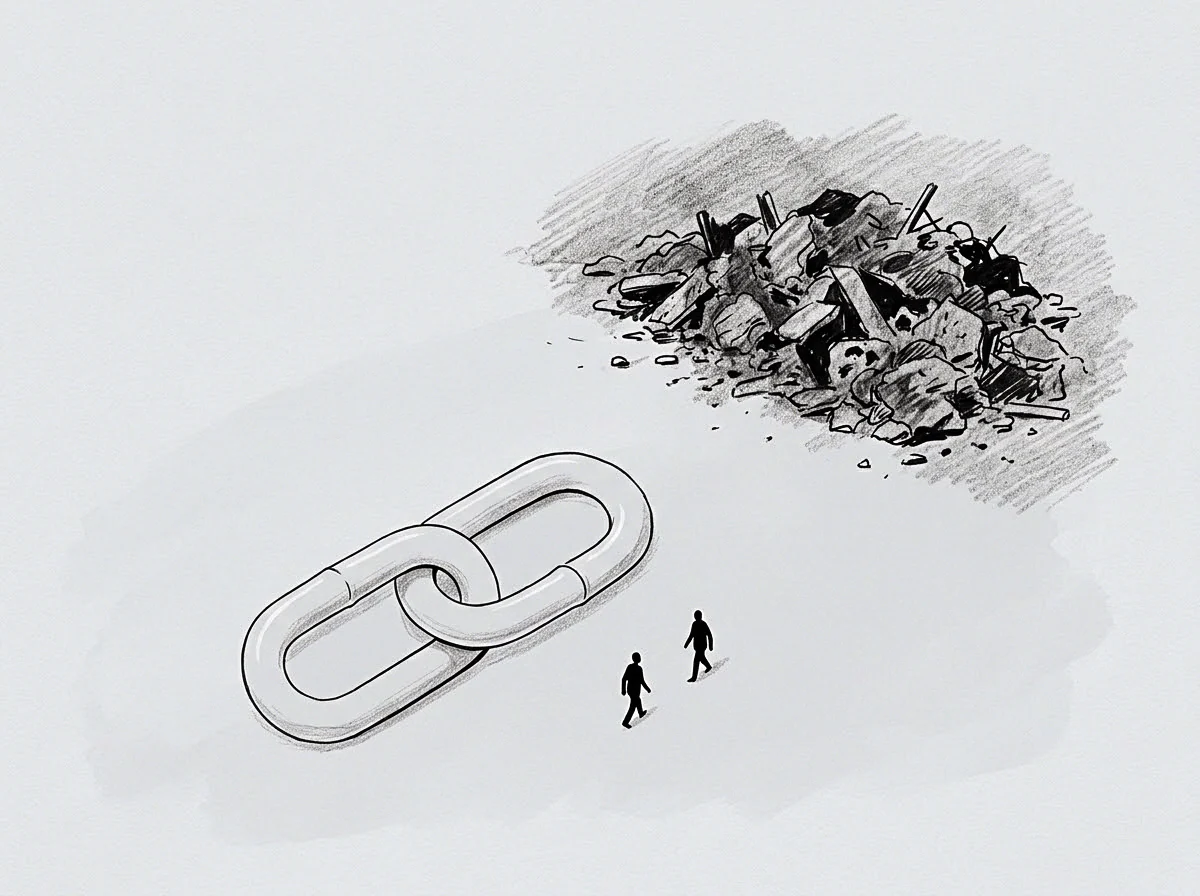
In naval engineering, compartmentalized steel bulkheads are installed across the hull of a ship. In calm waters, open spaces allow crew members to move freely and quickly without opening heavy pressure doors, but when lateral shear waves strike the hull during ocean transit, unsealed compartments flood simultaneously, causing catastrophic sinking. Watertight bulkheads create minor daily operational friction, yet they isolate breaches and preserve the vessel under stress.
Written legal instruments function as organizational bulkheads, isolating disagreements and preventing commercial collapse under market pressure.
Framing documentation around future investor diligence protects interpersonal trust during commercial formalization.

Introducing Written Terms Without Escalation
Presenting agreements as standard third-party requirements removes interpersonal friction from the documentation process. The active partner explains that an external audit, venture capital due diligence checklist, or commercial client insurance questionnaire requires definitive written agreements, shifting the motivation from internal distrust to collective corporate advancement.
The conversation must allow open space for partners to voice their internal recollections without judgment. When differences emerge regarding early promises, the focus remains on current commercial valuation and future upside rather than historical scorekeeping. Reaching an amicable settlement over past informal promises requires concessions on both sides: a collaborator may accept a lower equity percentage in exchange for enhanced board observation rights, expedited vesting, or guaranteed executive titles.
Institutional Preparation as Framing Protocol
The documentation process concludes with full execution of all formal agreements, corporate board minutes, and regulatory filings. Once executed, these documents must be stored in a centralized, secure corporate repository accessible to all parties, keeping physical copies alongside verified digital records. Memorializing unwritten promises transforms an unstable association of well-meaning individuals into a durable, bankable enterprise capable of weathering commercial friction.
Whether an early venture can survive the emotional discomfort of written formalization remains uncertain when partners equate legal precision with interpersonal suspicion.