
Preserving Local Message History Across Distributed Founder Communication Channels
Local message preservation extracts encrypted chat stores to write-once storage media, hashing raw database files to prove unaltered historical communications.
Dispersion
Thirty months into a commercial venture, an operator opens a messaging search window to retrieve an equity formula agreed upon during an early afternoon telephone conversation. The cloud workspace retains only ninety days of activity under its unpaid tier, truncating three thousand exchanges into blank screens. An informal side room inside a different chat client holds fragmentary confirmations, while a series of direct mobile transmissions sits isolated on a telephone replaced twelve weeks prior.
No central repository contains the complete narrative of the company’s formation.
Communication tools chosen during early operations scatter across proprietary networks, local devices, and encrypted conduits. Partners pick tools for immediate speed rather than administrative longevity. One participant works from a desktop workstation in a home office; another relies on a cellular handheld while traveling between production facilities.
Operational decisions accumulate across half a dozen closed software silos while vendors wipe unmanaged logs. A setting toggled by a platform administrator silently enables thirty-day retention limits across enterprise directories, discarding critical context without issuing export warnings to individual seats.
A team relying on hosted chat without local export capability forfeits its documentary record the moment subscription tiers change or administrative permissions fracture.

Chat Ephemerality and Channel Fracture
Modern communication systems favor ephemeral delivery over durable preservation. Ephemeral chat services discard transport payloads after delivery, leaving client caches empty once a session closes. Distributed founders frequently split discussions across disjointed systems: technical infrastructure in one tool, financial splits in a secondary private thread, and operational emergencies across cellular text services.
This segmentation fractures the evidentiary record into isolated scraps, and when memories diverge regarding capital commitments or ownership shares, no single computer possesses the entire conversational stream.
Unsynchronized directories diverge within weeks. Individual participants retain partial caches on their physical hardware, yet these local stores remain locked within proprietary database wrappers. Desktop clients for team messaging applications routinely store operational messages inside internal application data directories, commonly utilizing embedded SQLite formats or LevelDB log structures.
These local database files represent the sole surviving transcript of unrecorded verbal agreements once remote servers undergo administrative purging.
- Ephemeral channel purge discards daily operational exchanges whenever administrative retention windows elapse automatically.
- Client database isolation locks raw conversational records within proprietary application containers on unbacked machines, preventing unified search.
- Device transition attrition occurs when a participant replaces hardware without performing physical sector migration of hidden application support folders. One lost machine eliminates half the conversational record.
The Boundary of Remote Administrative Purges
Remote platform governance operates under commercial terms that actively oppose long-term founder recordkeeping. Enterprise administrative consoles grant single-account owners unilateral authority to wipe channel histories, downgrade workspace subscriptions, or revoke credentials without multi-party consent. A partner who controls workspace billing holds an unstated veto over historical evidence.
When disputes surface, unilateral credential revocation locks out the counterpart within seconds, terminating remote access to years of shared decisions.
Cloud backups managed by software vendors offer illusory security. These backups serve vendor disaster recovery obligations rather than customer preservation demands. Export utilities provided within commercial platforms routinely sanitize outputs, stripping out critical metadata such as unique message identifiers, client delivery timestamps, and original attachment blobs.
Reliance on cloud-hosted historical exports leaves a participant vulnerable to silent record alterations and retrospective data omission.
Disk
Physical drives inside local workstations retain data artifacts long after cloud applications report messages deleted. Operating systems allocate local storage space for chat client runtime data, caching plain text, image attachments, and cryptographic session logs inside hidden user directories. A founder seeking documentary preservation bypasses the vendor export tool, targeting instead the local file system where application state files reside directly.
Embedded databases provide the technical foundation of modern desktop messaging clients. Applications built on multi-platform desktop frameworks maintain SQLite databases containing structured tables for users, conversations, message snippets, and delivery receipts. These files sit inside application support directories on personal machines.
Even when an application purges its display cache, unallocated space inside local database blocks frequently retains deleted message strings until subsequent writing operations overwrite the sectors, leaving the local record recoverable.
A raw database extracted directly from local machine storage proves message existence even after vendor cloud logs undergo administrative deletion.
Extracting Local Storage Payloads
Acquiring verifiable conversational history requires locating and securing the physical files generated by client applications. The extraction process targets direct application directories: user configuration paths, local state repositories, and embedded message caches. A direct file copy operation performed while the client application sits closed preserves database file locks and prevents transaction write errors.
Forensic extraction focuses on three primary artifacts: the primary SQLite database file, write-ahead log files containing uncommitted transactions, and local cache directories containing external document attachments.
Forensic extraction tools and standard script environments allow operators to copy these repositories onto secondary media, where the filesystem timestamp records the date. The integrity of the extraction depends on maintaining exact byte replication without opening the operational client, as launching the software can trigger remote synchronization commands that issue local wipe instructions. Preserving the local folder structure maintains relational metadata between messages, participants, and outbound attachments.
| Preservation Format | Extraction Complexity | Metadata Fidelity | Tamper Vulnerability | Durability Over Time |
|---|---|---|---|---|
| Raw SQLite Database Copy | Moderate | Complete | Moderate | High |
| Vendor Cloud JSON Export | Low | Partial | High | Moderate |
| Forensic Disk Image Dump | High | Complete | Low | High |
| Decrypted Text Flatfile | Low | Low | High | Very High |

Comparative Retention Formats for Workstation Files
Preservation formats differ substantially in technical durability and legal utility. Raw database files retain structural relationships between individual messages, parent threads, and sender identities, but they depend on specific database engines for interpretation. Flat text files survive across decades without proprietary tools, yet they shed transport headers, edit histories, and message validation hashes, even if plain text outlasts format obsolescence.
Take two partners who incorporate a technical enterprise with an unwritten split of equity, operating across personal messaging channels for eighteen months without written corporate minutes. Assume the technical partner contributes software development labor while the commercial partner finances server costs from personal accounts, communicating purely via mobile messaging applications. When conflict emerges regarding initial vesting terms, vendor exports omit direct messages exchanged prior to workspace consolidation.
A preserved raw SQLite database taken from the commercial partner’s laptop proves the exact hour, wording, and attachment hash of the initial equity proposal, whereas a printed text copy provides zero cryptographic proof against claims of retrospective manipulation.
A stated retention condition requiring monthly raw database extraction to offline hardware changes conversational security from a contingent platform feature into an absolute participant asset.

Verification
Extracted data files possess evidentiary value only when their cryptographic integrity remains demonstrable. A file residing on an unmanaged drive invites accusations of alteration, fabrication, or selective deletion. Timestamp metadata generated by local file systems updates whenever a file moves across directories or opens within editing tools, destroying its chronological chain of custody.
True verification anchors local message logs to mathematically verifiable state proofs.
Cryptographic hashing algorithms calculate unique digital digests of extracted database files immediately upon acquisition. Generating a SHA-256 hash of a chat database file binds the file content to a specific mathematical signature that anchors authenticity. Any subsequent alteration to a single character, timestamp, or message state within that database changes the resulting digest completely, exposing the intervention.
Recording this digest on an external public ledger establishes indisputable proof that the file existed in that exact state on that specific calendar date.
A cryptographic hash generated on the day of extraction prevents opposing parties from claiming historical records were retrospectively fabricated.

Does Decentralized Storage Protect Early Commitments?
Decentralized storage networks and public cryptographic ledgers offer mechanisms to anchor message history outside the influence of company partners. Merkle trees compile thousands of individual chat messages into hierarchical hash structures, allowing participants to prove the inclusion of a specific message without exposing the entire conversational archive to public examination. Public ledgers provide absolute temporal anchoring.
Storing an encrypted archive on distributed storage nodes ensures that no single participant can delete the underlying file through platform disputes or corporate dissolution.
Significant operational friction accompanies distributed cryptographic storage. Encrypted payloads hosted across public networks remain subject to future cryptographic vulnerabilities; encryption standards deemed secure today may yield to computational advancements twenty years later. Furthermore, decentralized nodes require persistent payment mechanisms to maintain data pinning over decades.
If token deposits lapse, distributed storage providers drop archive pins as ruthlessly as proprietary software vendors delete unpaid accounts.
- Cryptographic hash generation records immutable mathematical fingerprints of raw database files at the exact hour of extraction.
- Merkle path validation verifies individual message authenticity within larger conversational sets without exposing unrelated discussions.
- Temporal ledger anchoring fixes the existence of data digests against public blockchains, proving records existed prior to legal disputes.
- Offline dual-custody signing requires both founding partners to apply digital signatures to monthly archive bundles, sealing historical consent.
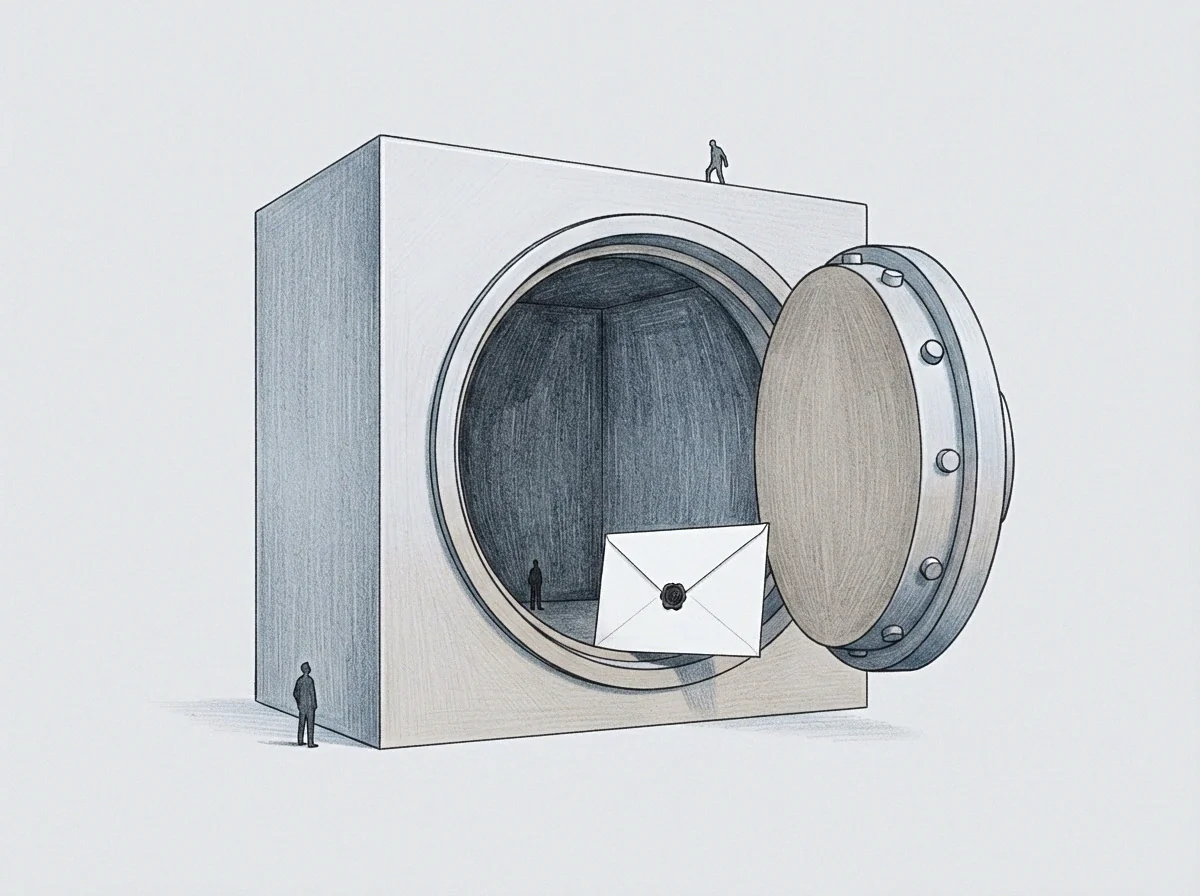
Reconstruction Errors in Unrecorded Dialogues
Human memory functions as an active reconstruction engine rather than a passive video recorder. Psychological research on human memory demonstrates that individuals rewrite past conversations to align with present financial interests, self-worth, and current personal tensions. Confidence in personal memory remains statistically uncorrelated with historical accuracy over multi-year horizons.
Two ethical operators can recall the exact same conversation with absolute subjective conviction while advancing contradictory factual claims.
Memory bends toward personal convenience. When an unrecorded discussion regarding dilution protections occurs during an informal automobile trip, both participants depart with divergent internal narratives. In 1932, early cognitive experiments demonstrated that recalled stories undergo systematic omission, rationalization, and conventionalization over successive retellings.
What people remember is their last retelling of an event, not the event itself. Without a preserved contemporary message transcript to arbitrate the dispute, friction escalates into irreconcilable legal deadlock.
In historical navigation, early maritime explorers maintained duplicate, independently locked logbooks to reconcile positional dead reckoning against magnetic drift before entering uncharted waters. The discipline did not eliminate storm damage; it eliminated retrospective disagreement regarding where the vessel had drifted. A local message record performs the identical task during corporate turbulence, leaving open only the question of whether founders possess the discipline to operate the extraction machinery before trust erodes.
Shelf
Preservation concludes at the physical storage medium. Modern solid-state storage drives experience silent bit leakage when left disconnected from power sources across multi-year spans. Enterprise cloud environments change identity verification requirements, locking historical accounts when legacy telephone numbers or corporate email domains expire.
The physical shelf provides the final boundary of data permanence.
Hardware isolation separates evidentiary archives from active corporate computing environments. Write-Once-Read-Many optical media, including specialized archival-grade optical discs, permanently engrave data pits into metallic alloy layers using industrial lasers. Once engraved, optical tracks resist physical modification, software viruses, remote administrator tampering, and power-loss bit degradation.
Storing a verified database file on an archival optical disc preserves the exact conversational record across decades without requiring continuous hardware maintenance.
Hardware media physically incapable of accepting secondary writes eliminate disputes regarding whether historical archives suffered silent administrative modification.
Cold Storage on Hardware Volumes
Deploying cold storage routines prevents operational accidents from compromising preserved history. Magnetic drives and solid-state hardware kept on disconnected shelves require deliberate storage protocols: climate-controlled enclosures, static protection, and systematic multi-generational rotation. Hardware interfaces undergo technological obsolescence within fifteen years.
An extraction stored on legacy media formats becomes useless if modern computing systems lack compatible physical ports and reading controller hardware.
Dual-medium storage combines modern accessibility with archival endurance. The operator maintains one working copy on a high-capacity local solid-state drive for immediate indexed searching, paired with a secondary master copy sealed on write-once archival media stored inside a secure physical safe. Because cloud access terminates without notice, physical media under personal possession guarantees access regardless of equity dilution, employment termination, or corporate bankruptcy proceedings.

The Routine of Immutable Mirroring
Systematic preservation requires mechanical operational discipline rather than episodic intervention. Establishing an unvarying monthly calendar habit transforms recordkeeping from an emotionally fraught accusation into standard administrative maintenance. On the final Friday of every operating month, the designated operator exports all local client database repositories, executes cryptographic hash verifications, mirrors the outputs to isolated media, and seals the digests inside a shared physical register.
Removing administrative friction ensures that conversational history survives across personnel departures, platform migrations, and partner fallouts, preventing claims from going undefended. The costs associated with buying external storage drives and dedicating three monthly hours to database extraction remain trivial when weighed against the catastrophic expense of unrecorded equity litigation.
Store two physical copies of every raw database on separate media in separate buildings before any conversation about ownership begins.