
A Claim With No Ground Under It
An unfounded claim distributes all operational risk to the executing party while a written instrument anchors legal ownership through verifiable terms.

Premise
Two Accounts of One Meeting
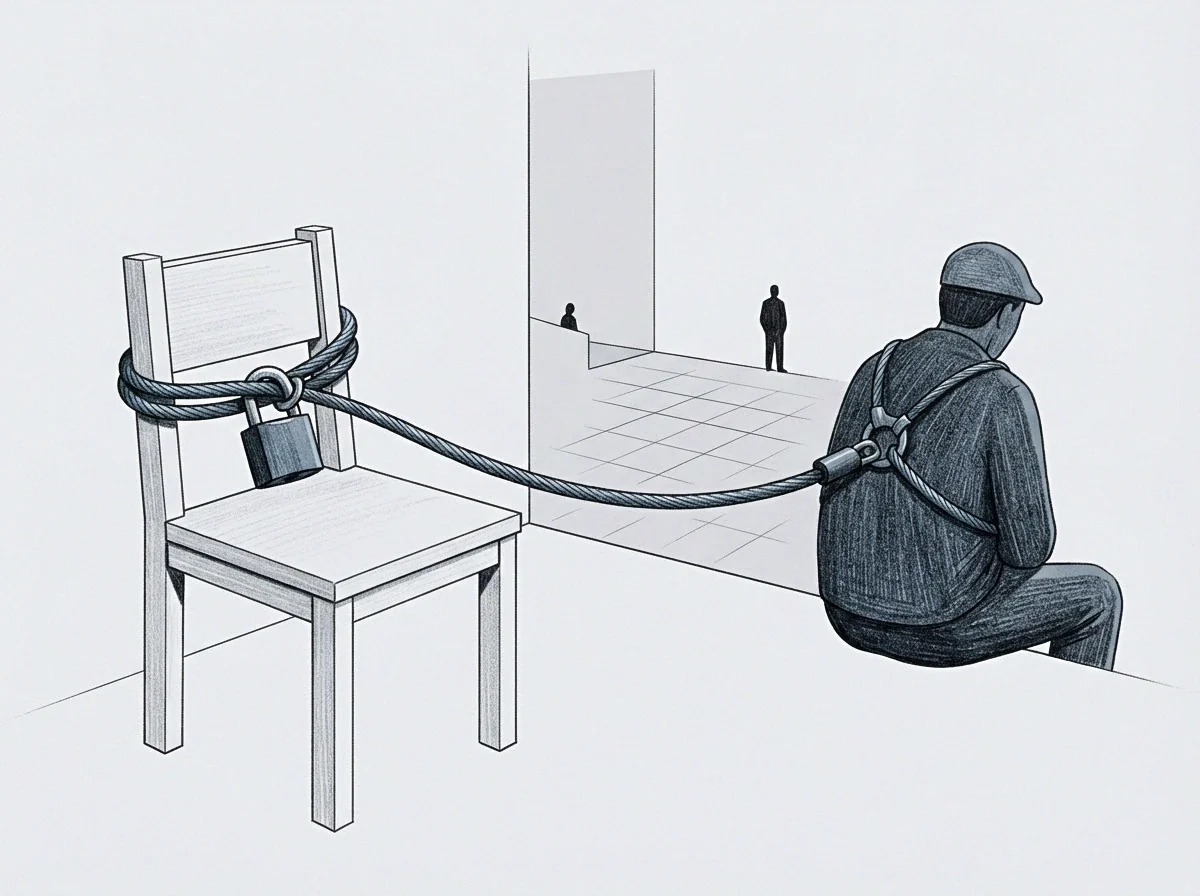
Two people sit in a room and speak about an arrangement before any asset exists. One person states fifty percent aloud while the other person takes notes on product features. Months pass while engineering proceeds on nights and weekends without a signed share registry or a corporate charter.
The speaker remembers a casual estimate of hypothetical division. The builder remembers an explicit grant of half the equity in exchange for unpaid technical execution.
This difference in recollection appears routinely when an arrangement lacks a written instrument. Human memory reconstructs past events to align with current self-interest and retrospective investment of labor. Without a dated record, an oral statement floats without evidentiary weight.
The speaker incurs zero legal exposure while the listener commits hundreds of uncompensated hours. The arrangement rests entirely on an unfounded claim that carries no contractual force.
A statement asserting future ownership remains inert until a signed instrument establishes legal transfer.
An unfounded assertion functions through asymmetric risk distribution. The person uttering the phrase risks nothing because words alone commit no capital. The person receiving the phrase absorbs the full operational burden.
When a venture fails, the speaker moves to another project without liability. When a venture succeeds, the speaker points to the lack of documentation to renegotiate the split downward.
Disputes over early equity distributions rarely stem from malicious deception. Cognitive psychologists document that individuals consistently overestimate their historical contributions to collaborative work. The party providing initial capital or an initial concept views early contributions as paramount.
The party delivering subsequent software development views technical execution as the sole driver of value. An ungrounded promise creates a divergence that widens with every month of unrecorded effort, leaving the contributor holding uncollectible promises when the entity incorporates.
Floor

Evidentiary Support and Contractual Ground
A claim gains structural stability only when specific legal, financial, or evidentiary foundations sit beneath it. A person evaluating a commercial assertion looks for three distinct forms of verification before deploying labor or capital:
- Written corporate instruments including signed operating agreements, stock restriction agreements, and option grants with defined vesting schedules.
- Verifiable transfer records consisting of bank transactions, executed intellectual property assignments, and documented capital contributions deposited into an entity account.
- Explicit contingency terms that state exact performance milestones, acceleration clauses, termination conditions, and exit provisions.
Oral promises possess zero resistance against subsequent dispute. Commercial dispute records demonstrate that equity claims based on conversations fail in arbitration without written corroboration. Even detailed text messages and informal notes leave ambiguity regarding vesting conditions and intellectual property title.
A commercial promise without an executed agreement transfers all operational risk to the executing party.
Contractual stability requires explicit boundary conditions. An effective agreement defines share classes, voting thresholds, departure terms, and dilution protections. When these terms remain unstated, the venture operates on assumed consensus.
Assumed consensus deteriorates the moment capital requirements force outside investment or an early collaborator chooses to exit.
| Dimension | Ungrounded Assertion | Grounded Claim |
|---|---|---|
| Legal Enforceability | Zero standing without written corroboration | Enforceable via executed corporate instruments |
| Labor Risk Allocation | Borne entirely by the executing party | Distributed according to documented vesting terms |
| Dispute Resolution | Dependent on reconstructed individual memory | Arbitrated through defined contractual clauses |
| Capital Valuation | Speculative projection stated verbally | Documented via capitalization table and banking records |
Verbal assurances degrade over time while written records retain exact wording regardless of subsequent relational shifts.
Motion
When Does an Unfounded Claim Become Irreversible?
Action converts hypothetical claims into permanent economic losses. When an engineer writes software for eighteen months based on an oral equity promise, the committed labor cannot be reclaimed. The committed hours represent sunk capacity that cannot be deployed elsewhere.
Decision science distinguishes between reversible choices and one-way actions. Resigning from a salaried position, writing production code, and signing personal loan guarantees represent one-way commitments. These acts cannot be unwound if the counterpart party alters the verbal arrangement.
The person executing the work pays for the claim through irreversible expenditure of personal capacity.
Irreversible labor expenditure converts a verbal promise into a permanent personal liability.
Consider a typical commercial scenario. An operator agrees to manage product distribution for a fledgling software company based on a verbal promise of thirty percent equity. The operator leaves a secure corporate role, works twelve months without salary, and secures the first one hundred paying accounts.
When the company raises an institutional financing round, the primary shareholder offers an employment contract with one percent option equity. The shareholder asserts that the initial thirty percent figure reflected an informal thought experiment rather than a binding ownership split.
The operator holds no legal leverage to compel compliance with the original conversation. The primary shareholder notes that without a signed capitalization table, no ownership transfer occurred and the early labor constituted voluntary collaboration.

Split

Separating the Asset from the Relationship
Dissolving an unfounded arrangement requires systemic separation of personal trust from operational mechanics. The process involves four sequential phases:
- Audit of existing contributions where the parties document all written code, customer contacts, capital advances, and intellectual property developed to date.
- Presentation of formal instruments containing precise equity splits, vesting schedules, and governance rights for immediate execution.
- Cessation of uncompensated labor pending the execution of binding legal documentation.
- Formal assignment or withholding of assets based on whether fair compensation or equity title is delivered.
Introducing formal legal instruments tests the validity of previous verbal claims. A counterpart party who spoke in good faith signs the drafted agreement with minor adjustments to standard terms. A counterpart party who used the verbal claim to extract uncompensated labor refuses to sign or delays execution indefinitely.
A refusal to sign written terms reveals that the prior verbal claim carried no genuine intent of execution.
An operator facing a refusal to sign halts development immediately. Continuing to build on an unsigned promise compounds exposure. Withholding further intellectual property creation prevents additional uncompensated value transfer.
An executed assignment agreement containing an explicit IP holdback clause changes the negotiation by establishing legal ownership over unassigned software code.

Weight

The Long-Term Record of Unfounded Commitments
Operating without legal foundations imposes severe long-term friction on commercial entities. Early informal promises remain dormant until a venture achieves liquidity, acquisition interest, or major institutional investment. At that stage, early contributors emerge to assert historical claims based on past conversations, emails, and informal notes.
Institutional investors conduct rigorous due diligence on capitalization tables and intellectual property chain of title. Unresolved verbal equity promises create legal clouds over corporate ownership. In severe instances, unresolved claims stall acquisitions or force founders into costly out-of-court settlements to extinguish potential litigation.
The record outlasts individual memory. What was spoken casually in a dining room five years prior becomes a commercial liability during an acquisition audit. Written clarity established on day one protects all participants from retrospective distortion and preserves the enterprise value built through collective effort.
How many commercial enterprises founder not from technical inadequacy or market rejection, but from the delayed structural collapse of an ungrounded promise made in their first ninety days?